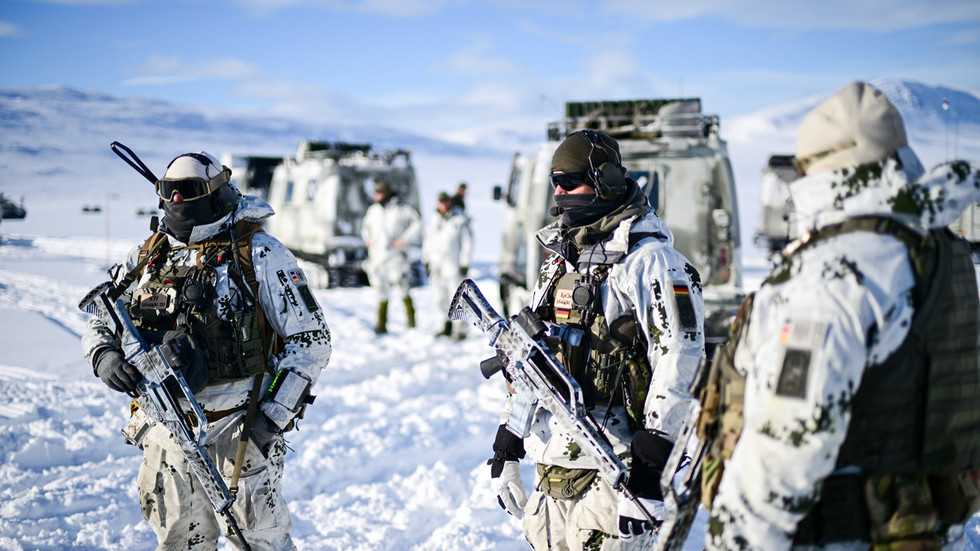
The bloc’s members are increasingly treating the Far North as another arena for containing Moscow and its partners Published 31 Aug, 2026 02:13 | Updated 31 Aug, 2026 05:20 FILE PHOTO: NATO troops stand in the snow during the military exercise Cold Response 26, on March 15, 2026. © Global Look Press / dpa / Sebastian Gollnow NATO is seeking to turn the Arctic into a new “hotbed” of tensions with its active military buildup in the region, Russian Foreign Minister Sergey Lavrov has warned. The bloc’s activities have sowed an atmosphere of distrust and it is risking a potentially dangerous armed confrontation not only with Moscow but with other nations as well, he warned in an article published by Arctic.ru on Monday. The US-led military bloc ramped up its activities in the Far North earlier this year by launching the Arctic Sentry initiative. The move was touted as a response to US President Donald Trump’s effort to annex the Danish autonomous territory of Greenland on the grounds that it was allegedly under threat from Russia and China. Both Moscow and Beijing have repeatedly dismissed the accusations, with China arguing that the US was merely using the claims as a pretext for its own military buildup in the Arctic. Russia has also maintained that it would defend its interests in the Arctic, despite having no stake in the feud over Greenland. In his Monday article, Lavrov stated that Russia is mainly interested in “preserving the Arctic as an area of peace and cooperation” while accusing NATO of “driving the region towards militarization.” “Intensive military preparations are underway in close proximity to our northern borders. NATO is conducting large-scale military exercises involving non-regional countries and introducing new components of its command-and-control system,” the minister said. Back in February, the NATO nations held drills focused on Greenland and the broader Arctic, involving Swedish and Danish warplanes in particular. In March, the bloc staged a massive military exercise in Norway and Finland – two Nordic nations bordering Russia – involving a total of 32,500 troops from 14 member states. The troops trained on the territory of both countries, as well as “at sea and in the air,” under “harsh, Arctic conditions,” in what the Norwegian Armed Forces described as the nation’s “largest military exercise in 2026.” Last week, US, UK and Norwegian forces kickstarted another drill on the Norwegian island of Jan Mayen. The operation is aimed at integrating “multinational sensors, command-and-control nodes and precision fires into a joint kill web,” according to a US Marine Corps release. Jan Mayen – a remote volcanic island located 1,000 kilometers away from mainland Norway – is described by the US Naval Institute think tank as a key location in the Greenland-Iceland-UK gap – a “chokepoint against entry into the Atlantic Ocean by Russian naval forces” and particularly its Northern Fleet. “NATO members and other Western countries make no secret of their true motives, openly declaring their intention to turn the Arctic into a new front for opposing the development of Russia and its like-minded partners,” Lavrov said, commenting on the development and warning that such an approach “increases the risk of incidents that could trigger an armed confrontation with potentially disastrous consequences.” The foreign minister also stated that NATO and the EU not only pose a “direct threat” to Russian security but also seek to “undermine Russia’s legitimate rights in international cooperation” by targeting its partners with sanctions that affect Arctic projects in particular. He named China and India as Moscow’s key partners in the region. The EU has targeted Russia with numerous rounds of sanctions, including restrictions aimed specifically at its Arctic oil and gas development. The measures were designed to restrict Moscow’s access to technologies required for deep-water drilling and Arctic resource extraction, as well as to limit financing for such projects. According to an April report by the Institute for China-America Studies, the sanctions have made Arctic cooperation between Moscow and Beijing more complicated, as Chinese companies fear they could be targeted with secondary restrictions if they invest in large-scale joint projects. READ MORE: Major Asian exporter tests Russian Arctic shortcut to Europe However, despite NATO seeking to turn the Arctic into a new front, Lavrov maintained that Moscow is ready to work “with all constructively minded foreign countries displaying reciprocal readiness” to respect Russia’s interests.